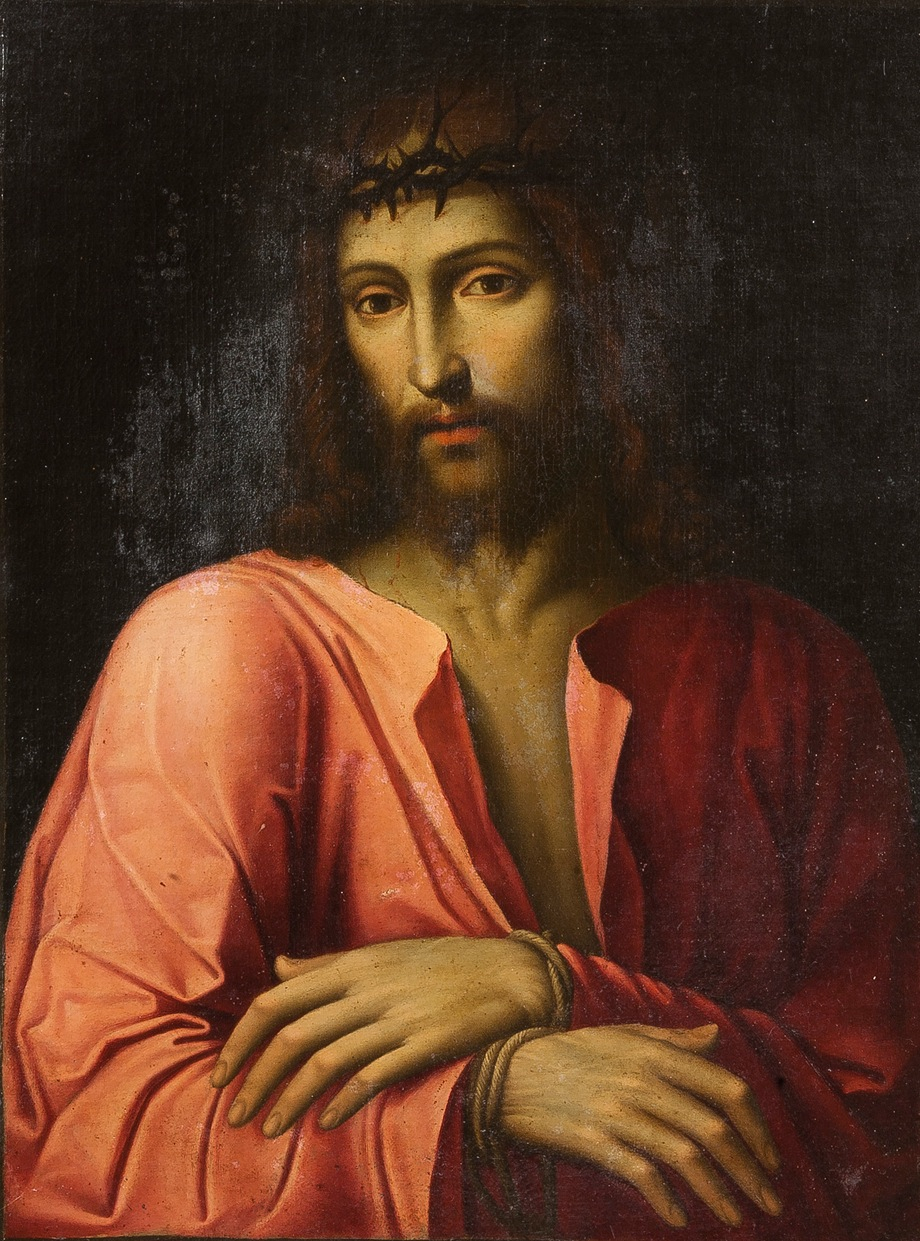
Marcello Venusti, Ecce Homo, 16th century
“What you say about Jesus says more about you than it does about Jesus.” — Richard Smoley
The other day I was introduced to this couple and we were bonding about the affect of music on courtship. As they were explaining how they met, I asked them their astrological signs. I could sense an inner eye roll from the guy, a lawyer, even though he was too polite to do it to my face, which isn’t always the case. I doubt my new friend knew very much about astrology, but it appeared that he knew enough to consider it totally ridiculous. This was far from the first time I’ve experienced the anti-occult eye roll treatment and it didn’t really bother me, but it did get me to start thinking about people’s preconceptions about the Mysteries, and many other delights of the spirit world.
We humans are categorizing creatures, which is essential to our survival, but which can also make us blind to that which doesn’t fit neatly into our world view. Most of us have experienced walking by a familiar thing, like a tree or a house in our neighborhood, and realizing that we’ve never noticed it before. As soon as we saw it we slipped it into a category, “tree”, and then dismissed it. When that happens to me I always end up wondering what else I am missing out on. Probably a lot.
Part of the importance of an education in the arts, both the esoteric and the fine arts, is that it can help us to look more closely, it can help us to see all the things around us hidden in plain sight. When we practice looking closely (and then looking closely again, and then again) at a text, or a painting, or person, we can begin to see beyond the categories we normally ascribe to that object. We start to see its suchness, its uniqueness in all the world. We begin think about its history and context. By looking closely, whole new worlds, both interior and exterior, begin to open up.
But even artists and others involved in intellectual culture frequently dismiss the occult and people who are interested in it. Fascination with the occult is identified as being so much New Age psychobabble. It’s a general human tendency to dismiss things we don’t understand, or to think we understand all too well things of which we are totally ignorant. For example, current scholars of anthropology acknowledge that, in early studies on “shamanism” or “witchcraft”, when Europeans studied people from indigenous cultures, the Western scholars frequently misunderstood the ceremonies they were witnessing. (Pels and Meyer, 2003, p. 8). More than learning about a foreign culture, these early anthropologists were often just reifying their own identities as “rational, scientific thinkers,” by identifying the practices of the indigenous communities as non-rational and superstitious. In reality, the anthropologists probably had no more idea what was going on in these communities than I would if I went to a physics conference (I’m interested in physics but by no means an expert, I’d surely be lost). However, if I went to a physics conference, most people would rightly consider me annoying if I rolled my eyes at all the things I didn’t understand and implied that the physicists were idiots for believing in it, or even talking about it. But that just demonstrates how we privilege scientific knowledge over almost any other form of knowing in contemporary culture.
People also seem to feel very comfortable making wild assumptions about art (really this whole post is about how people love to make wild unfounded assumptions in general – and I can be as guilty as the next person). Take Duchamp’s Fountain for example. For several years I taught art history, in addition to a bunch of other subjects, at a trade college. Like most of art’s uninitiated, upon first seeing Fountain my student’s would often be either outraged, disgusted, or just totally dismissive. “How is this art?? This is trash. Anyone could do this. Why should this sh** be treated as if it’s good art?” Eye rolls abounded. It’s perfectly reasonable that they would have this reaction; it’s part of the intention of the work. But by the end of the course, students would often have had a change of heart, some would even claim Dada as their favorite art historical movement. Anyone who knows anything about Western art in modernity, even if they don’t like or appreciate Dada, can surely see that there is a lot more going on in Fountain than initially meets the eye. But if the art student doesn’t stick around to learn more, or doesn’t stop to think on their own, then they will walk around saying that Duchamp was a fraud and Dada was a bunch of bullsh**. (Yes! Dada doesn’t mean anything! Bravo!). I remember saying similar things about Akira Kurisawa’s Dreams when I first saw it at thirteen. I thought it was boring and left the theater (I still cringe about that, I guess at that time I wanted a flashier, faster-paced otherworld). Most artist’s and intellectuals would recognize these assumptions as a form of ignorance, understandable ignorance, but ignorance none the less. And yet artists and intellectuals often feel perfectly comfortable talking about things they don’t understand as if they were experts. We’ve all done this, I think. Whenever I think of times I’ve bad-mouthed things or people I didn’t understand I cringe. Consequently you can sometimes find me cringing in line at the super market or while stuck in traffic.
The point is, it’s human nature to categorize and make assumptions. None of us is without sin in this regard. But it’s a dangerous practice and personally I think it’s worth it to shine the light of awareness on our behaviors in effort to overcome them. The principle that allows people to scoff at astrology, or Marcel Duchamp, or the idea of an atom or evolution, is the same principle allows the so-called authorities to invade countries we know nothing about and expect positive outcomes. GuvCorp goes into ecosystems, nations, uteruses, without considering the opinions of the people and beings who live there. This is outrageous, unloving, ultimately destructive behavior. And the cure for this kind of illness/ignorance, is to listen more, pay attention more, and to adopt a position of humility, curiosity, and compassion.
The enlightened practitioner doesn’t follow the occult in order to use spells or astrology to “magically” solve all their problems. As I see it, a commitment to magic is an act of rebellion, it’s an act of defiance against cynical lack of imagination and slavish faith in an ugly, petty, un-magical worldview. Allegiance to the Mystery is not just about considering the position of Mercury before you buy a major appliance; it’s a practice, moment by moment, of subverting destructive ignorance and devoting yourself to liberation, to rekindling the imagination of the world, in the name of Love, and celebration of the Mystery.